Design Your Own Halloween Costume: From Idea to Wearable in Two Weeks
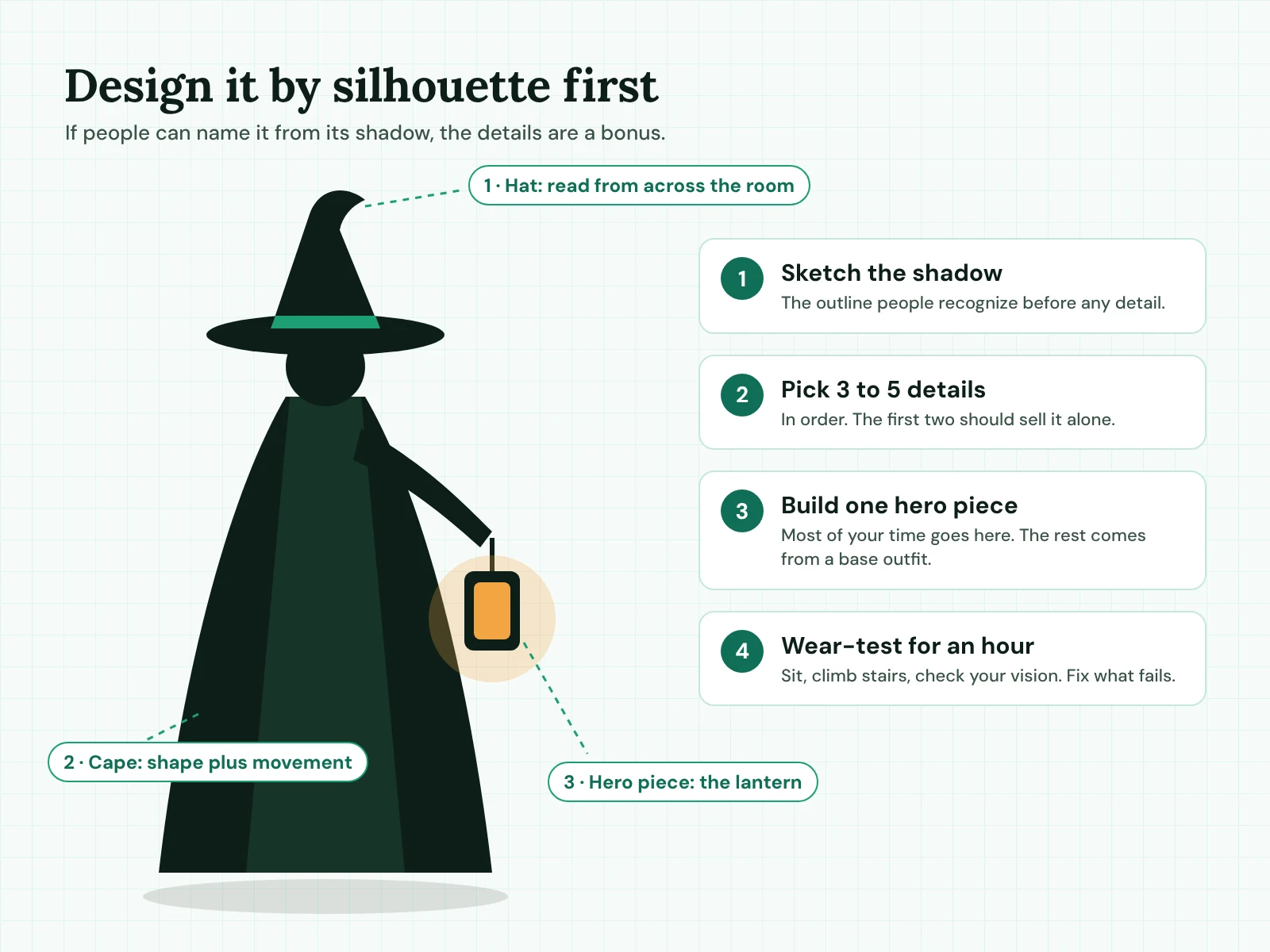
Design a Halloween costume by starting with the silhouette, the outline people recognize from across a room, then choose the three to five details that sell it. Build from a thrifted or store-bought base, make one hero piece, and test-wear the whole thing for an hour before the night.
The best homemade costumes aren't the most detailed. They're the ones people recognize from across the room, that still look good at 11pm, and that the person wearing them can actually move, sit and eat in. That's design, and you can do most of it yourself.
Start with the silhouette
Before you buy anything, sketch the outline of the costume: the shape you'd see if the person were a shadow on a wall. Big hat, long cape, wide shoulders, a tail, a giant prop. Recognizable costumes almost always read by shape first and detail second.
Then list the three to five details that sell it, in order. If you only finished the first two, would people still get it? If not, the list is in the wrong order.
Pick one hero piece
Spread your time evenly and everything looks a little unfinished. Pick one hero piece, like the helmet, the jacket, the prop or the makeup, and put most of your effort there. Everything else can come from a thrift store, your closet or a cheap base costume you modify.
Build on a base
Few people sew a costume from scratch, and they don't need to. Start with something that already fits: a thrifted jacket, a plain dress, a hoodie, sweatpants dyed the right color. Modify it with paint, trim, patches or foam pieces attached with straps or snaps.
Materials that do most of the work
- EVA foam. Armor, helmets, props and big shapes. Cuts with a fresh utility blade, curves with a heat gun, glues with contact cement. Seal it (with a flexible primer or several coats of glue) before painting or the paint cracks.
- Cardboard and paper. Mock up every big piece in cardboard before you cut the good material. It's how you find out the helmet doesn't fit over your head while it's still free.
- Thrift store clothes. The cheapest way to get fabric that already has a shape.
- Fabric paint and spray paint. Most of the "aged" or "battle-worn" look is dry-brushing and dark wash over a base coat.
- Elastic, snaps, buckles and safety pins. What holds a costume together at a party. Glue alone usually doesn't.
Safety, in plain words
- Fumes. Contact cement, spray paint and heat-sealing foam all give off fumes. Work outside or with windows open and a fan, and use a respirator rated for organic vapors if you're doing a lot of it. Heat guns burn skin and scorch foam fast.
- Vision. Masks and helmets that cut off side and downward vision cause most costume falls. If you can't see your feet, change the design. For kids, face paint beats a mask.
- Fire. Long capes, wigs and fake beards near candles and jack-o'-lanterns are a real risk. Look for "flame resistant" on store-bought pieces and keep the trailing parts short.
- Skin. Test makeup, face paint and spirit gum on a small patch of skin 48 hours before the night.
- Eyes. Decorative or "special effect" contact lenses should only come from an eye doctor with a prescription and a fitting, never from a costume shop or website.
- Kids out at night. Reflective tape on the front and back, a flashlight, and a hem that clears the shoe.
A two-week plan
- Days 1 to 2. Pick the idea, sketch the silhouette, list the key details, set a budget.
- Days 3 to 4. Shop the base outfit and materials. Mock up the hero piece in cardboard or scrap.
- Days 5 to 9. Build the hero piece. Seal and paint. Build the smaller pieces.
- Days 10 to 11. Put it all together. Add straps, snaps and stitches anywhere glue is doing all the holding.
- Day 12. Wear test for an hour. Patch-test makeup.
- Days 13 to 14. Fix what broke in the wear test. Pack a repair kit.
Where someone experienced earns their keep
Most of a costume is easy. Usually there's one piece the whole thing hinges on, like a helmet that has to look right, a garment that has to fit, a makeup look that has to hold up for six hours, or LEDs that have to stay lit. That's where an hour or two with a costume maker, cosplayer, seamstress or makeup artist beside you pays off. They'll show you the technique on your own project, so you finish it yourself, and know how to do it again next year.
Checklist
Design Your Own Halloween Costume: From Idea to Wearable in Two Weeks
0 of 14 done
Design
Build
Wear test
Want someone who knows standing next to you?
Find a costume maker near you →The Field Guide is written by AlongSide.Guide. AlongSide connects you with Guides who get paid to work alongside you, and some links on this page go to it.
Questions people ask
Your three options
Guides who do this
No Guides for this yet. Know this job? Be the first, and your Offer shows up right here.
Know this job? Become a Guide.
Become a Guide →This guide was written by AI and hasn't been reviewed by a person yet. Know this subject? Sign up free as a Guide, add your credentials, and submit a review. Every review is checked by our team. If it's approved, your name and credentials go on this guide as its reviewer, linked to your Offers.
Sign up free as a Guide →